I Solved 650 LeetCode Problems and It Didn't Make Me a Better Developer
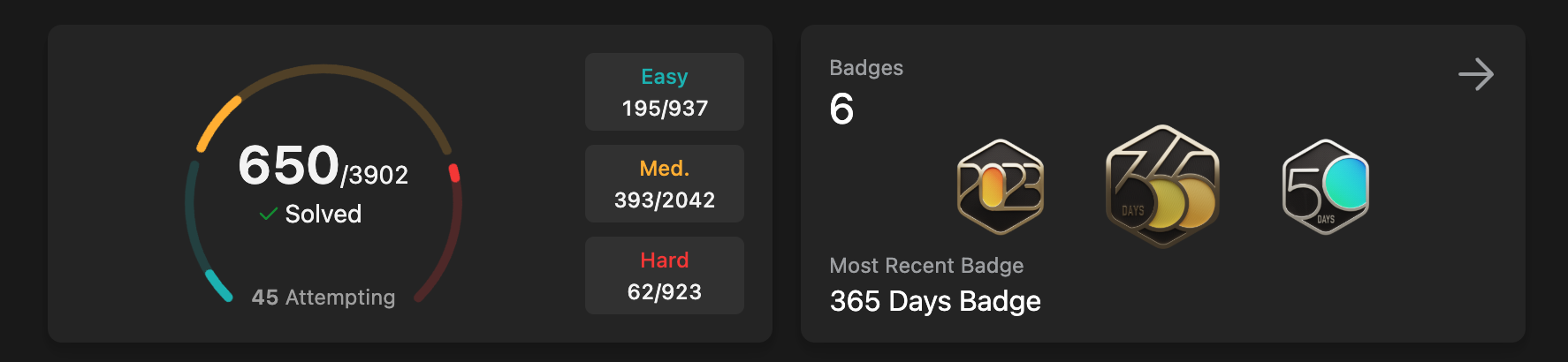
Competitive programming taught me how to think. Production engineering taught me that thinking isn't enough.
I'll say it upfront: I was addicted to LeetCode. 650 problems. 150+ on Codeforces. I could binary search in my sleep, implement segment trees before breakfast, and argue about time complexity the way people argue about football. I was, by every competitive programming metric, good.
Then I got my first real client. A non-technical founder in Germany who needed a production application built, maintained, and extended over two years. And within the first week, I realized something uncomfortable: almost nothing I'd practiced for hundreds of hours mattered here.
The Lie We Tell Beginners
The developer internet has a consensus pipeline: grind LeetCode, pass interviews, become a great engineer. It's clean. It's measurable. It gives you a dopamine hit every time you see "Accepted" in green.
But it optimizes for the wrong thing. LeetCode trains you to solve isolated, well-defined problems with a single correct answer under artificial time pressure. Professional software engineering is the exact opposite: ambiguous requirements, no single correct answer, and time pressure that spans months, not minutes.
Nobody on LeetCode teaches you what to do when your client changes the spec on a Thursday night and expects the feature live by Monday. Nobody teaches you that the "optimal" solution is often the one you can ship, debug, and hand off to another developer without a manual.
The hardest problem I solved in production wasn't an algorithm. It was convincing a non-technical stakeholder that the "simple" feature they wanted would require restructuring the entire data model — and then doing it anyway when they said "just make it work."
What 650 Problems Actually Taught Me
I'm not here to tell you competitive programming is useless. That would be dishonest. Here's what it genuinely gave me:
01 — Pattern recognition under pressure. When a production bug is burning and you have 30 minutes before a client demo, the ability to read code fast and identify structural issues quickly matters. CP trained that reflex.
02 — Comfort with complexity. I don't panic when I see a nested data transformation pipeline or a recursive state machine. That tolerance for complexity came directly from contest training.
03 — Ego calibration. Getting destroyed on Codeforces by a 15-year-old in Belarus teaches you that being smart isn't a competitive advantage. Being useful is.
That third one is the most important, and it's the one competitive programmers talk about the least.
What It Didn't Teach Me
Here's the longer list. The one that matters more for anyone trying to build a career writing software for money.
How to scope work. A client says "build me a dashboard." That's not a problem statement. That's a negotiation. What data? What access levels? What happens when the data is wrong? What does "real-time" mean to them? LeetCode problems come pre-scoped. Real work never does.
How to write code that survives contact with other humans. My competitive programming code was write-once, read-never. Single-letter variables. No comments. Functions that do seven things. It worked for contests. In production, code like that is a liability. I had to completely retrain how I write.
How to say no. On LeetCode, you solve every problem that's put in front of you. In freelancing, the most important skill is identifying which problems you shouldn't solve. Which features aren't worth building. Which clients aren't worth taking. I learned this slowly, expensively, and only after saying yes to things I should have declined.
How to communicate technical decisions to non-technical people. "I used a hash map for O(1) lookups" means nothing to your client. "This approach means the search will stay fast even when you have 100,000 products" means everything. Competitive programming gives you zero practice at translation.
How to handle the absence of a test suite. On LeetCode, you know immediately whether your solution is correct. In production, you ship code and sometimes don't discover it's broken for weeks. You learn to write defensively, to think in failure modes, to treat your own code with suspicion. None of this is practiced in contest environments.
The Pivot Nobody Talks About
There's a phase every competitive programmer goes through when they start building real products. I call it the performance trap. You over-optimize everything. You reach for clever solutions when a simple loop would work. You spend three hours shaving milliseconds off a function that runs once per user request.
I did this constantly during my first production project — a product catalog system for industrial manufacturers. I was writing the most algorithmically elegant code of my life, and my client didn't care. They cared that the CSV import worked, that the role-based access was correct, that Stripe charges went through. Performance wasn't even in their top ten concerns.
The gap isn't skill. It's orientation. Competitive programming points you inward — toward the elegance of your solution. Production engineering points you outward — toward the person using what you built.
That reorientation took me the better part of a year. And the only way I got through it was by shipping real software for real people who were paying real money. Not by solving another 200 problems.
What I'd Tell Myself Two Years Ago
Stop at 200 problems. Seriously. By that point you've internalized the major patterns: sliding window, two pointers, BFS/DFS, dynamic programming, greedy. Everything after 200 is diminishing returns unless you're specifically training for ICPC or targeting a FAANG interview slot.
Take the remaining time and build something. Not a tutorial project. Something where you make the architectural decisions, you handle the deployment, you deal with the user who found a bug at 11pm. That's where the real learning is. It's slower, messier, and less satisfying in the moment. But it compounds in ways that contest ratings never will.
I still have my competitive programming reflexes. They still help. But they're maybe 10% of what makes me effective as a developer. The other 90% came from the work that doesn't have a leaderboard.
The Bottom Line
Competitive programming is a sport. Software engineering is a trade. They share some underlying muscles, but training for one doesn't prepare you for the other. If you're grinding problems because you love the puzzle, keep going. But if you're grinding because you think it's the path to becoming a great developer — stop. Go build something that breaks. Go work with someone who doesn't know what an API is. Go ship code that you'll be embarrassed by in six months.
That's where the actual growth is. I promise you it's not hiding behind problem #641.
Shamil — Freelance full-stack developer. Ex-competitive programmer. Building software for clients from Ethiopia.